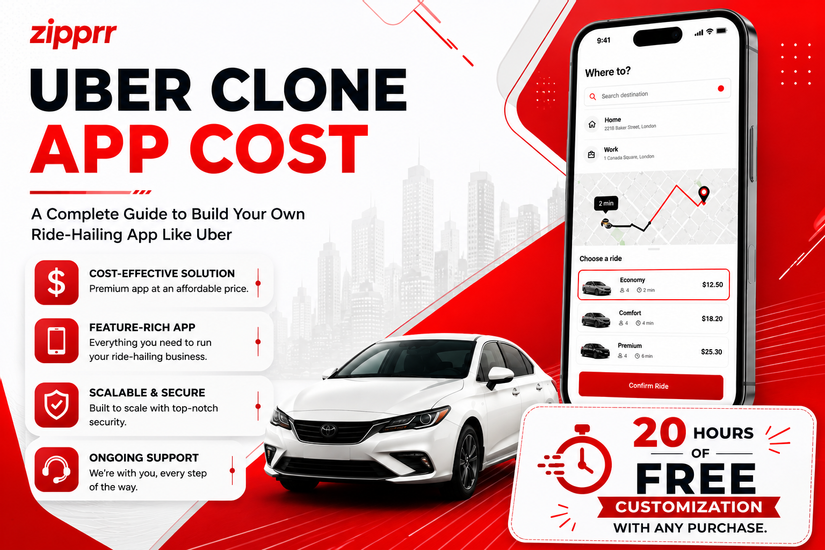
With Zipprr, an Uber Clone costs just $89 on the Startup plan or $490 on the Pro plan, and it's delivered in 3–7 days. Building the same ride-hailing app from scratch would run $25,000 to $120,000+ and take many months — so a ready-made Zipprr clone is a fraction of the price and time. Why most "cost" answers are misleading People assume a ride-hailing app must cost a fortune, because the headline number for a custom build truly is huge. But "Uber Clone" covers everything from a stripped-down demo to a production-grade platform with rider, driver, and admin apps. The Uber Clone script from Zipprr gets you the full core engine — bookings, dispatch, payments, maps — for $89 or $490, because the heavy engineering is already done and tested.
Custom builds cost more because you're paying for discovery, UI design, backend architecture, and months of QA. With Zipprr, those costs are amortized across every buyer, so you inherit a mature codebase on day one instead of funding the whole experiment from a blank repository.
What the two Zipprr plans include
The choice is simple. The Startup plan at $89 is built for founders who want to launch lean and validate demand fast. The Pro plan at $490 suits operators who want the fuller feature set and more room to scale. Both ship with the core rider, driver, and admin apps, and both are delivered inside the same 3–7 day window. You're not choosing between fast and affordable — with a white-label Uber Clone from Zipprr, you get both.
The costs that sit outside the license
Two buyers can pay the same Zipprr price and still have different running totals. App-store developer accounts, an SSL certificate, and a domain are small but real. Then there are ongoing services — map and SMS APIs, payment-gateway fees, and server hosting — which scale with your ride volume, so they start small and grow as you do. None of that changes the headline: your software cost with Zipprr is $89 or $490, not five figures.
Why this pricing changes the math
The smartest way to frame cost is as an investment against revenue. When a ride-hailing app development project costs you $490 and goes live in a week, the payback window is tiny — a handful of commissioned rides. Compare that to a custom build that ties up six figures for a year before earning a cent. Founders who think in time-to-revenue almost always land on Zipprr, because every month of delay carries its own hidden cost in lost rides and lost market share.
How to get the most value
Start lean. Launch on the $89 Startup plan, prove demand in one city or niche, then upgrade to Pro as you grow. Buyers who try to build every feature before launch usually overspend and ship late. Zipprr's model flips that: you go live in 3–7 days and let real riders teach you what's genuinely worth paying for. Review the full Uber Clone pricing to see exactly what each plan covers.
See it before you buy
If you want a feel for what $89 or $490 actually buys, request a live Uber Clone demo from Zipprr and click through the rider, driver, and admin flows yourself before committing a dollar.
Bottom line
For startups and fleet operators, Zipprr's Uber Clone at $89 (Startup) or $490 (Pro), live in 3–7 days, is the smartest entry point into mobility. You skip the expensive groundwork, launch in a week instead of a year, and keep your capital for marketing and driver incentives — which is what actually wins riders.